
from Dr Ralitsa Madsen & Team
Dear CLOVES Syndrome Community readers,
As we approach the festive season, I am once again excited to share this year’s update with you. Writing this newsletter is always one of my favourite responsibilities of the year. It is a chance to step away from the endless to-do-list and reflect on the meaningful progress we have made.
For those who may be reading one of my updates for the first time: I am Dr. Ralitsa Madsen, and my research group studies the PI3K signalling pathway – the biochemical system inside our cells that is disrupted in PROS. Our mission is to understand and predict how PIK3CA mutations change the behaviour of cells and tissues, and to use this knowledge to guide safer and more effective treatment strategies.
This year, I am especially excited to share that we have reached the final stage of what has truly been a tour de force of disease modelling since I started the lab. After several years of hard work and continuous support from my mentor and collaborator, Prof. Robert Semple, we now have a comprehensive collection of human induced pluripotent stem cells (iPSCs) carrying a wide range of activating PIK3CA mutations. Thanks to Prof. Semple, we have also revived precious patient-derived cells from my time in Cambridge – samples originally donated by individuals in the PROS community. These are incredibly valuable resources, and we are eternally grateful to the patients who made this possible.
What makes this milestone transformative is that, for the first time, we are able to model PIK3CA mutations in the correct human cell type – and to do so at scale using the iPSCs we have generated. We began with endothelial cells, which form the inner lining of blood vessels and are central to the vascular malformations so often seen in PROS. Over the past three months in particular, our team has seen first-hand just how critical it is to study PIK3CA mutations in precisely engineered, human venous endothelial cells. Without the right cell type, some mutations may look completely “silent”, even though we know they cause debilitating disease. I experienced this myself during my PhD, when one of the less potent PIK3CA mutations showed no measurable effect in the iPSC lineage itself. Conversely, if one uses the non-human model systems or does not control carefully for the exact dosage of each mutation, there is a risk that conclusions are drawn that do not reflect the true biology of the human condition. Unfortunately, this remains a challenge in the field, and it is one of the reasons why I often caution against overinterpreting scientific studies that do not model PROS in a sufficiently realistic way, especially if the authors do not acknowledge such limitations upfront. Ultimately, no model is perfect but we have got to be honest in our reporting about it.
Now that we have the appropriate endothelial models, we can study the true biology of the many PROS mutations. We can see clear, quantifiable differences that closely recapitulate key aspects of the human pathology. This is an incredibly important step forward. And the timing could not be better. In fact, the first week of December, we will be running our first full drug-targeting experiment using these disease-relevant models. We will be testing clinically approved medicines, as well as the Relay Therapeutics drug currently in clinical trials. Our goal is to directly compare how different PIK3CA mutations respond in the correct cell context – something that has never been done systematically before.
To give you a sense of what we now have available:
• engineered iPSCs with H1047R and E545K, each linked to fluorescent reporters so we can track when they become endothelial cells
• patient-derived iPSCs carrying H1047R, E418K, and others that are yet to be brought out of storage
• the ability to produce arterial and venous endothelial cells reliably and at scale; funding permitting, this will be expanded upon in coming years to capture a wider range of PROS-relevant cell types
We hope to share the first results publicly early next year. This will open the door to many follow-on studies, and, we believe, a clearer path toward more precise and personalised therapeutic strategies.
A major transition for our lab
Another significant update is that our entire research group will be relocating to the CRUK Scotland Institute and the University of Glasgow, with the move planned for mid-January 2026. Although this comes at a difficult moment – the University of Dundee has been facing severe financial challenges – the team has handled the uncertainty with unwavering resilience. The move will undoubtedly be stressful, but it also brings enormous opportunity. In Glasgow, we will be joining a thriving research environment with outstanding facilities and collaborators.
One idea I am particularly keen to explore, together with partners in the UK and internationally, is the possibility of establishing a secure and ethically governed PROS patient tissue biobank. Many of you have expressed interest in contributing biopsy material to support research, and we want to develop a practical pathway that ensures such donations are meaningful, well-preserved, and maximally valuable for downstream studies. This cannot be done without careful infrastructure and will likely require long-term planning and investment, but I am hopeful that it is possible and that Glasgow will be the place to build it.
Looking ahead: more engagement and involvement
Once we have settled into the CRUK Scotland Institute, I am keen to offer quarterly live lab updates for anyone in the PROS community who would like to learn more about our work. These will be held online and will include the option to see the lab virtually, meet team members, and hear what we are working on in real time. I hope this will make the research process feel less distant, and offer a window into why rigorous science – especially science that aims to be clinically meaningful – often takes longer than we all wish it would. I would be keen to hear from the PROS Community whether this would be of interest.
Closing remarks
In closing, I would like to thank you – sincerely – for your patience, your trust, and your continued interest in our research. The work we are doing is slow by necessity, but this year we have crossed a critical threshold. We now have the right models, in the right cell types, and we are finally able to ask the mechanistic and therapeutic questions that matter most.
We look forward to sharing much more progress with you in 2026.
Until then, we wish you and your loved ones a very Merry Christmas and a Happy New Year.
With warmest regards,
Dr. Madsen and Team
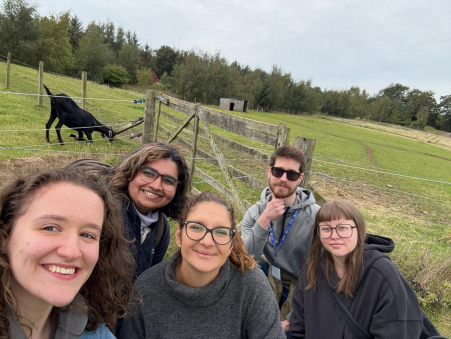
This is us with our lab mascot, Oreo. We adopted Oreo from a nearby farm here in Scotland and visit him regularly for a catch-up! From left-to-right (excluding Oreo): Alex Musk (PhD student), Sweta Swaminathan (PhD student), Dr. Ralitsa Madsen (group leader), Mark Bekala (research technician), Oliwia Mruk (PhD student).
For a quick lesson on Induced Pluripotent Stem Cells (iPSCs), see this video on CSC’s YouTube channel, published in 2023.